Case Study
Guided Troubleshooting for a Connected Product Ecosystem
I worked on a mobile app for a connected product ecosystem. A recurring challenge was connectivity issues between the app and the connected hardware, resulting in a high number of support requests. My goal was to help users resolve technical issues independently and with that reducing reliance on customer support.
Role
Lead UX Product Designer
Duration
1.5 years
Focus
Research • UX Concept • Testing • Analytics • Stakeholder Alignment
Confidentiality note
This case study has been anonymized to protect confidential client and company information. For this purpose, visuals were recreated and project details have been modified or omitted. The focus is on my role, design process, and approach.
The Challenge
- Not knowing the technical source of the occurring issue and finding troubleshooting steps that actually work
- Reducing the interaction flow to a bare minimum while still providing all necessary information. Users often have a short attention span due to the issue being time-critical.
- Supporting users with varying levels of technical knowledge
Activities & Responsibilities
- Coordinated product owners, developers, technical experts, support agents, and feature teams to align on troubleshooting concepts and priorities.
- Conducted research with technical experts and support agents to understand failure scenarios, root causes, and existing troubleshooting processes.
- Designed and iterated user flows and UI concepts using the existing design system while accounting for localization and implementation requirements.
- Planned, facilitated, and evaluated testing workshops as well as in-person user testing sessions to validate design decisions.
- Defined success metrics and analytics concepts, continuously monitored performance, and used insights to drive future iterations.
Key Design Decisions
Troubleshooting Funnel
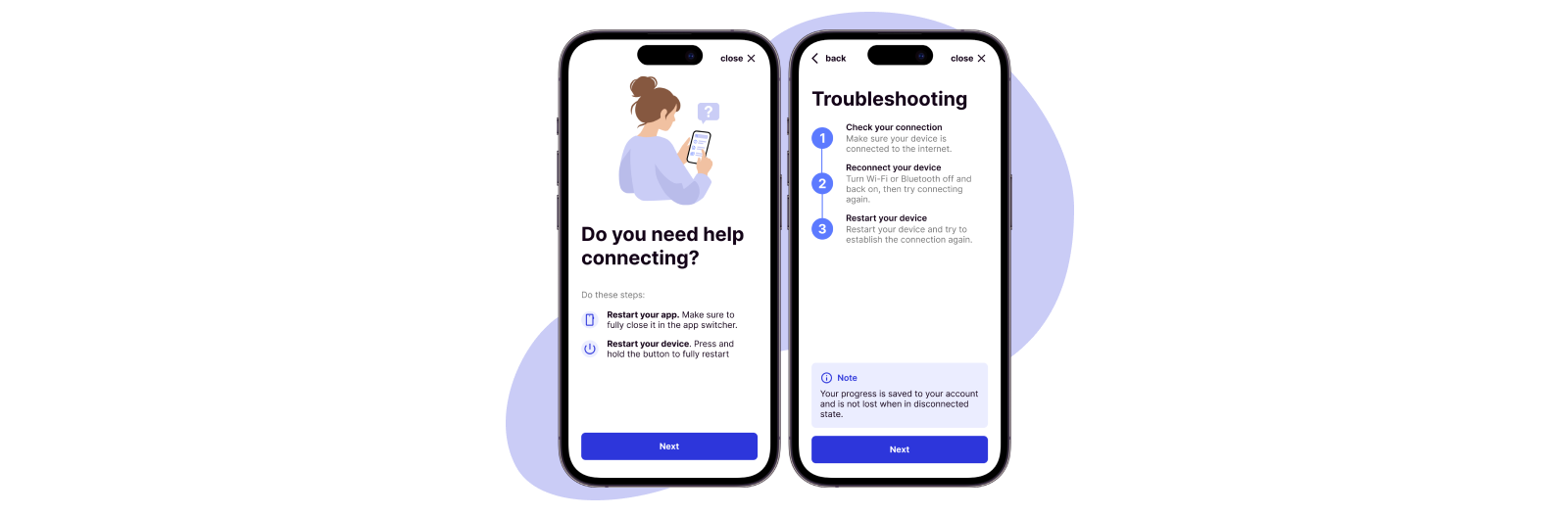
Instead of presenting all possible troubleshooting steps at once, I designed a layered approach. Users first received the fastest and most effective actions, while more advanced troubleshooting was introduced further down the funnel.
Evidence over Assumptions
Several troubleshooting steps were historically part of existing support processes, but lacked evidence of effectiveness. By validating assumptions through testing and data, we simplified the flow and focused on actions that delivered measurable value.
Continuous Optimization
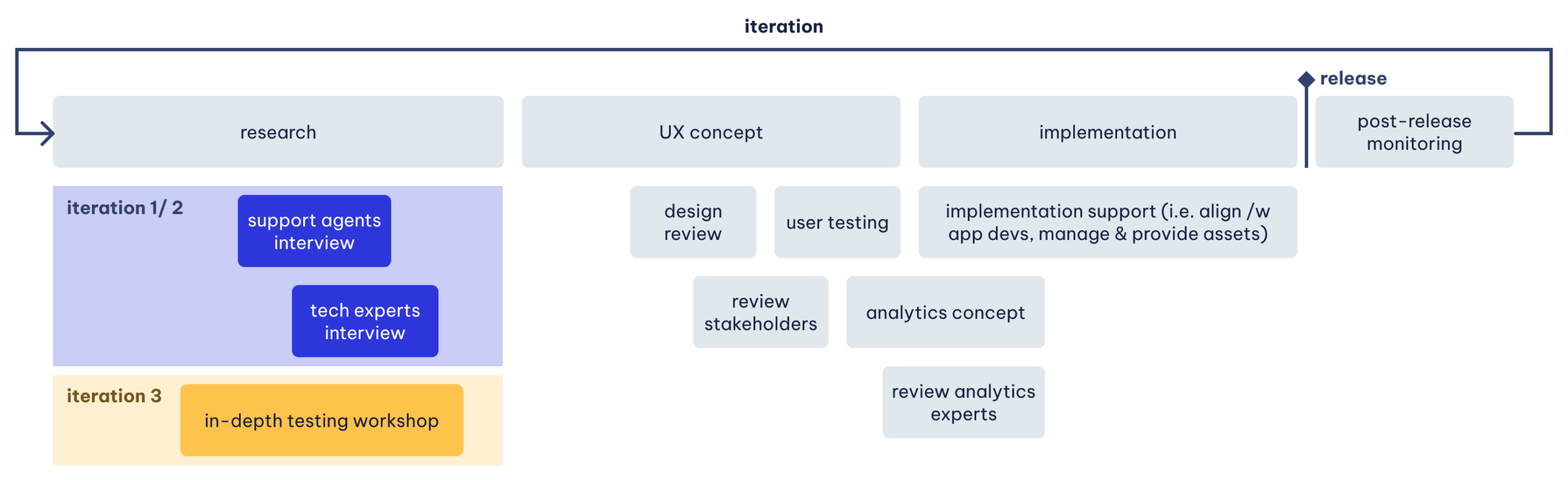
Rather than treating the feature as a one-time release, I established analytics and success metrics that enabled continuous improvement through a Build → Measure → Learn approach. In parallel, we aligned troubleshooting guidance across multiple support channels to create a more consistent user experience. The solution underwent 3 major iterations.
Outcomes
- Approximately 25% immediate success rate for users entering the troubleshooting flow
- Unified troubleshooting approach across multiple teams
- Improved internal support processes
Retrospective
Over the course of 1.5 years, I was the primary UX driver for this area, working closely with technical experts, support teams, developers, and product stakeholders. Having the opportunity to continuously learn from real user behavior, measure outcomes, and evolve the solution over multiple iterations gave me a much deeper understanding of the problem than would have been possible in a shorter project.
What started as an initial concept went through three major iterations, each informed by user feedback, analytics, testing, and newly gained insights. The contrast between the early concepts and the final experience clearly demonstrates the impact of continuous learning and incremental improvement.
The experience reinforced my belief that meaningful product improvements rarely come from getting everything right the first time. They emerge from taking ownership, staying curious, challenging assumptions, and continuously learning from users.